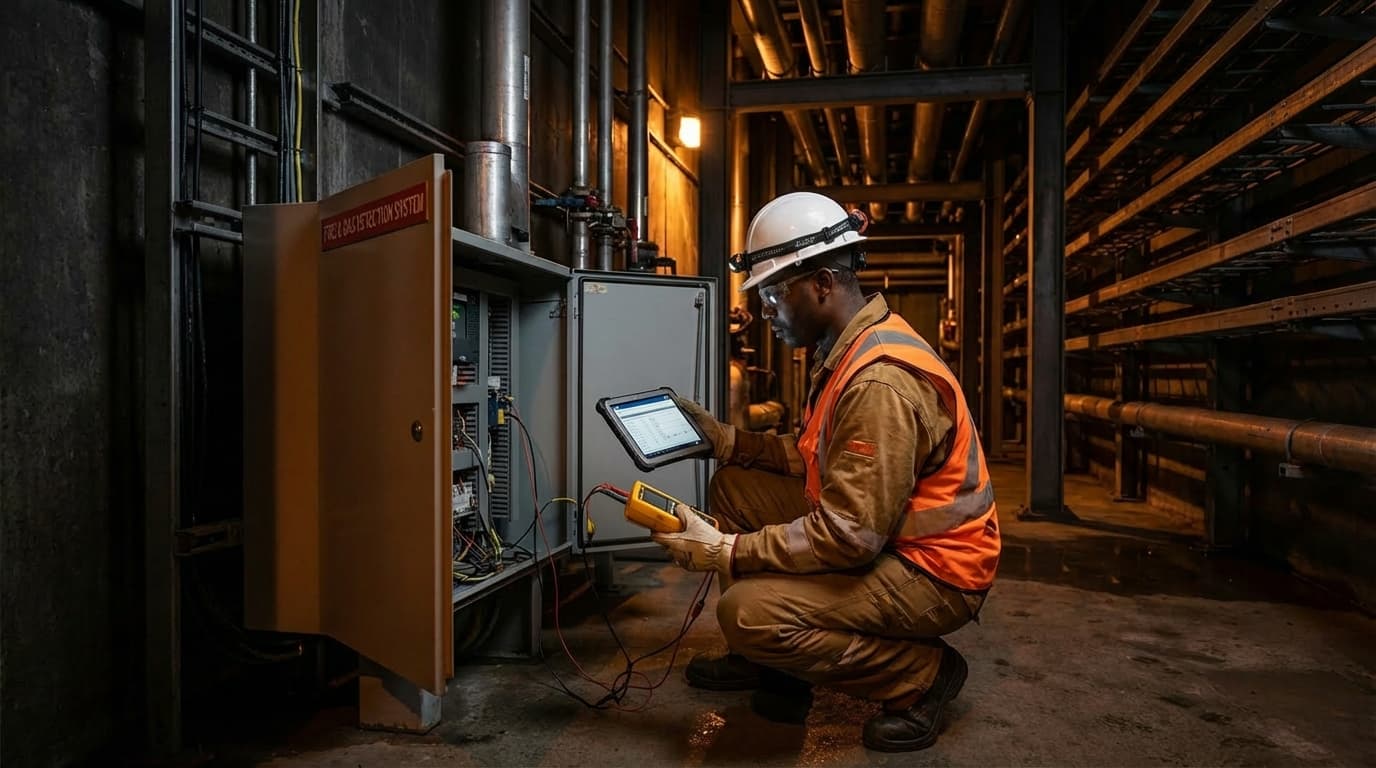
Audio deep dive
5:15What a green status light does—and does not—prove
A two-host discussion about what status indications, loop checks, detector tests and commissioning records prove—and what they leave unproven.
Editorial note: This AI-produced discussion is an accessible companion to the written guide and may simplify or paraphrase technical and regulatory points. For precise terminology, standards references and engineering boundaries, refer to the written article and its cited sources. Always follow the applicable OEM instructions, approved site procedures and project-specific engineering requirements.
The central commissioning question
Can the team trace an approved requirement through the installed detector, wiring, I/O, logic and required plant action—and show that every temporary test condition was safely removed afterwards?
Define the proof boundary
Commissioning proves the installed chain—not every future hazard scenario
A process F&G system is built to detect defined fire, combustible-gas or toxic-gas conditions and initiate specified responses. Commissioning demonstrates the parts of that design intent covered by the approved tests. The claim must stay inside that boundary.
That matters because a green status light can coexist with a field-of-view obstruction, a wrong tag, a disabled output or a mismatched cause-and-effect line. Each test closes a different part of the evidence chain.
Stimulus
Detector
I/O
Logic
Action
Sequence the evidence
Eight phases turn separate checks into an accepted system
Projects may name or group the phases differently. The important discipline is to define what each stage proves, its entry criteria, witnesses, records and exit decision.
- 01
Pre-commissioning
Confirm approved documents, installation completion, identification, wiring, power, earthing, certificates and test readiness.
- 02
FAT / FIT
Demonstrate configured automation and interfaces against the agreed specification before shipment, where included in the project.
- 03
SAT / SIT
Confirm the delivered system and its site interfaces after installation, using the agreed acceptance plan.
- 04
Loop checks
Prove field-to-system signal identity, scaling, direction, status and output continuity for each loop.
- 05
Detector commissioning
Apply the model-appropriate stimulus and verify the installed detector, local indication, signal and configured alarm behaviour.
- 06
Cause and effect
Test each required input condition, voting path, delay, alarm and executive action against the approved matrix.
- 07
Integrated testing
Prove the required interactions with ESD, DCS, HVAC, PAGA, firewater or suppression interfaces within the agreed boundary.
- 08
Acceptance and handover
Close critical defects, reconcile every inhibit, preserve configuration and test evidence, train users and complete the site approval gate.
Prevent scope gaps
Four systems can share interfaces without sharing one standard or certificate
Industrial sites often use “fire and gas” as an umbrella term. Commissioning plans must be more precise because process detection, building alarms, gaseous suppression and safety-instrumented functions have different purposes and acceptance routes.
Process F&G
Open process areas and loss-of-containment hazards. The design basis may include flame, combustible-gas and toxic-gas coverage, voting and mitigation interfaces.
ISA-TR84.00.07 and project F&G philosophy
Building fire alarm
Life-safety detection, alarm and evacuation functions in non-domestic buildings. Its commissioning and certificate route is not proof of process-area F&G performance.
SANS 10139 where applicable
Gaseous suppression
Detection and release logic plus the mechanical agent system, enclosure and safety provisions. It needs its own correctly scoped acceptance evidence.
Applicable SANS 14520 parts and project basis
ESD / SIS interfaces
Only the functions identified as safety instrumented functions sit inside the IEC 61511 lifecycle. An F&G interface is not automatically a SIF.
IEC 61511 where the function qualifies
Name the exact scope
“The standard requires it” is not enough
The governing edition, system boundary and contractual status should be written into the test basis. A guidance document can become contractually required, but that does not turn it into South African legislation.
IEC 62381:2024
Defines FAT, FIT, SAT and SIT requirements and checklists for process-industry automation systems. It is a useful acceptance framework, not a substitute for detector commissioning, loop records or site validation.
ISA-TR84.00.07-2018
Addresses evaluation of fire, combustible-gas and toxic-gas detection-system effectiveness in process areas, including coverage and system performance considerations.
IEC 60079-29-2:2015
Provides guidance for selection, installation, use and maintenance of equipment detecting flammable gases and oxygen.
IEC 62990-2:2021
Provides corresponding guidance for equipment measuring toxic gases and vapours in workplace atmospheres.
SANS 10139
Applies to fire detection and fire-alarm systems in and around non-domestic buildings. Do not extend it to open process-area F&G by implication.
SANS 14520 series
Addresses gaseous fire-extinguishing systems. The applicable part, agent and project edition must be identified rather than citing the series as one universal procedure.
Boundary: IEC 62381 defines specific automation acceptance tests. It should not be cited as proof that the entire detector, loop, C&E, integrated-test and operational-readiness programme has been completed.
Prepare before energisation
Testing should start from controlled inputs—not assumptions
- 01Approved F&G philosophy or design basis and the final cause-and-effect matrix
- 02Instrument index, detector schedule, layouts, mapping basis and tag/location cross-reference
- 03Loop, I/O, wiring and interface drawings with current revisions
- 04Detector datasheets, certificates, OEM manuals and configuration records for the installed model
- 05Approved test procedures, inspection and test plans, acceptance criteria and blank result sheets
- 06Defined witnesses, signatories, permits, risk controls and responsibilities
- 07Inhibit, override, isolation and restoration procedure with a live register
- 08Calibrated reference equipment and in-date test media appropriate to the exact detector
If the final C&E matrix, test acceptance criteria or installed model instructions are missing, the team cannot reliably distinguish a passed test from a test that merely produced activity.
Follow the exact manual
Gas and flame detectors cannot be commissioned from one generic recipe
The safe, valid test method depends on sensor technology, target gas, cross-sensitivity, firmware, accessories, output configuration and installation. Even devices from one manufacturer can use different procedures.
For example, some detector instructions specify calibration gas concentration and flow through a dedicated adapter. Some optical flame detectors use a named simulator; other models perform automatic optical-integrity checks and explicitly state that an external test lamp is not required. The model manual decides.
Exact test medium
Target gas, surrogate gas, zero method and concentration must come from the installed sensor instructions and approved procedure.
Exact delivery method
Flow, pressure, adapter, tubing material, exposure time and warm-up requirements vary by model and gas.
Exact optical method
A test lamp is not universal. Some flame-detector families require a specific simulator; others use automatic optical-integrity testing and state that an external lamp is not required.
Exact output behaviour
Maintenance current, alarm relays, latching, delays, HART status and inhibit behaviour must be checked against the configured device and logic.
Avoid false confidence
Every test proves something—and leaves something unproven
What it proves
Internal diagnostics, communications or a configured status path.
What it does not prove
Exposure to the real test stimulus, installed orientation or every external action.
What it proves
Tag identity, wiring continuity, scaling, polarity and signal path to or from the system.
What it does not prove
Detector sensitivity to gas or flame, coverage, voting logic or integrated plant action.
What it proves
The installed device responds to the approved physical stimulus and sends the expected signal.
What it does not prove
Every C&E branch, remote interface, final element or untested hazard scenario.
What it proves
The programmed input condition produces the required alarms, voting, delays and outputs.
What it does not prove
That a field detector can sense the hazard unless the test starts with a suitable physical stimulus.
What it proves
The agreed chain works across detector, I/O, logic and connected systems within the test boundary.
What it does not prove
All future environmental conditions, all release scenarios or performance beyond the approved design basis.
Control temporary states
An inhibit is part of the test—and part of the risk
Testing may require suppressed alarms, isolated final elements, software forces or release prevention. Each one temporarily changes the protective configuration. A credible programme makes that change explicit and proves the return to normal.
Authorise
Identify the function affected, reason, owner, duration and permitted compensating measures before applying the inhibit.
Make visible
Record the point in the live register and show the inhibited or isolated state clearly at the relevant system and work area.
Minimise
Limit the number, duration and functional extent of inhibits to what the approved test requires.
Restore
Remove the force, bypass or physical isolation and confirm that the normal configuration is reinstated.
Re-test and reconcile
Functionally verify the restored path where required, close the register entry and reconcile all open items before handover.
Test the required responses
Cause-and-effect testing is a controlled comparison—not an improvised alarm demonstration
For each matrix line, the team needs a defined initial state, input condition, expected voting and delay, required outputs, permitted isolations, witness and recorded result. A mismatch should become a controlled defect, not an on-the-spot undocumented logic change.
Example evidence path
Input condition
Actual detector stimulus or a documented simulation at the agreed point.
Logic response
Voting, alarm, delay, latching, reset and interface behaviour.
Safe restoration
Final elements restored, forces removed and normal state reconciled.
Preserve the baseline
The dossier should let another competent team reconstruct what was tested
- Approved FAT, FIT, SAT and SIT records included in the project scope
- Loop-check sheets and detector commissioning records by tag
- Test-gas cylinder identification, concentration and certificate details where used
- Cause-and-effect results showing expected versus actual response
- Integrated-interface test records and final-element isolation references
- Calibration and reference-equipment evidence relevant to the tests
- Complete inhibit, override, bypass and restoration history
- Punch-list status with safety-critical acceptance decisions recorded
- Final configuration backups, approved software versions and as-built drawings
- Training, operating handover and the site’s formal pre-startup approval record
The project responsibility matrix should name who performs, witnesses, reviews and accepts each record. Those roles differ by system and jurisdiction; they should not be inferred from a generic title such as “commissioner.”
South African context
Regulation creates duty-holder obligations—not a universal F&G test procedure
Section 8 of the Occupational Health and Safety Act creates a general employer duty to provide and maintain a working environment that is safe and without risk to employees. It does not prescribe one fire-and-gas commissioning sequence.
The Major Hazard Installation Regulations, 2022 establish duties around classification, risk assessment, major-incident prevention, safety reporting, licensing and emergency arrangements for covered establishments. They can make reliable risk-control evidence important, but they do not provide the detector-by-detector F&G commissioning method.
SANS 10139 and the SANS 14520 series should be applied only to their building fire-alarm and gaseous-suppression scopes. Current competency, registration and certificate requirements must be confirmed for the exact contracted activity. No single SAQCC Fire category should be presented as proof of competence for every process F&G, mapping, ESD or SIS task.
PSSR
Pre-startup safety review is a useful international benchmark and common project gate. OSHA 29 CFR 1910.119 is United States law, not South African legislation.
Readiness decision
The South African duty holder and project governance must define the authorised local gate before hazardous inventory or process conditions are introduced.
A practical pre-live readiness check
- The approved design basis and acceptance criteria are available and controlled.
- Installation, loop, detector, C&E and required interface tests are complete for the agreed scope.
- Safety-critical defects are closed or handled through the site’s formal risk and acceptance process.
- Every temporary inhibit, force, override and isolation is reconciled and the required normal state is proven.
- Configuration backups, as-builts, test records, operating procedures and training are available to the duty holder.
- The site’s authorised pre-startup review and decision process is complete before hazardous inventory is introduced.
Five misconceptions
The shortcuts that create the most dangerous confidence gaps
“The FAT passed, so the site system is ready.”
FAT can prove configured functions in a controlled factory environment. It does not prove site installation, field wiring, detector orientation, final interfaces or restored operating state.
“A healthy self-test means the detector is commissioned.”
Diagnostics are valuable, but their proof boundary is model-specific. Commissioning still needs the approved installed-device and system tests.
“A loop check is an end-to-end commissioning test.”
A loop check proves the signal path. It does not, by itself, prove physical detection, C&E logic or the final action.
“One fire registration or certificate covers every F&G activity.”
Building fire alarm, gaseous suppression, process F&G and SIS work have different scopes and competency evidence. Confirm the exact work and applicable scheme.
“Once commissioning is complete, the system remains proven.”
Commissioning is a baseline. Maintenance, proof testing, impairment control and management of change are needed to preserve the evidence.
Common questions
Fire and gas commissioning questions plant teams ask first
What is the difference between FAT, SAT, a loop check and commissioning?+
FAT and SAT demonstrate agreed automation-system requirements before and after site delivery. A loop check proves the field signal path. Commissioning is the broader programme that brings installation, detector response, logic, interfaces, records, restoration and operational acceptance together.
What does a cause-and-effect test prove?+
It proves that a defined input condition or voting state produces the alarms, delays, outputs and executive actions required by the approved matrix. If the input is simulated, the test does not also prove that the field detector responds to a real gas or flame stimulus.
Which documents should be ready before site testing starts?+
At minimum, the approved philosophy, final cause-and-effect matrix, detector and I/O schedules, current drawings, OEM instructions, acceptance procedure, test sheets, responsibility matrix and inhibit-control process should be available for the agreed scope.
How should commissioning inhibits and bypasses be controlled?+
They should be authorised, visible, recorded, limited to the approved test, reviewed at handover and formally restored. The restored path should be functionally checked where the project procedure requires it.
Who accepts the final commissioning dossier?+
The project responsibility matrix should define the tester, witnesses, reviewers and duty-holder acceptance authority. Different signatories may apply to process F&G, building fire alarm, gaseous suppression and SIS work, so the role must not be assumed from one certificate or registration.
Authoritative references
Sources and further reading
Six supplied research reports were consolidated for this rewrite. Conflicting claims were resolved against current IEC and ISA catalogue records, South African government publications and original manufacturer instructions. Full standards remain subject to licence and project edition control.
- IEC — IEC 62381:2024, FAT, FIT, SAT and SIT
- ISA — ISA-TR84.00.07-2018, F&G system effectiveness
- IEC — IEC 60079-29-2:2015, flammable-gas and oxygen detectors
- IEC — IEC 62990-2:2021, toxic-gas and vapour detectors
- SABS — SANS 10139:2021 Edition 4 catalogue record
- SABS — SANS 14520-1:2019 Edition 3 catalogue record
- South African Government — Major Hazard Installation Regulations, 2022
- South African Government — MHI Regulations implementation update
- OSHA — 29 CFR 1910.119 pre-startup safety review benchmark
- Dräger — Polytron 7000 model-specific calibration instructions
- Det-Tronics — X5200 model-specific optical-integrity instructions
What this article does not promise
This article does not claim that Touch Teqniques Engineering holds a particular SAQCC Fire registration, ECSA category, functional-safety certification, SANAS accreditation or approved-inspection-authority status. It does not guarantee legal compliance, regulator acceptance, zero false alarms, detection of every release scenario or a specific commissioning duration. Exact test methods, acceptance criteria, signatories and operating-readiness decisions remain project-, model- and duty-holder-specific.
Research status
Source-led technical briefing
Primary standards and South African regulatory sources checked
This article was rebuilt from a consolidated technical research pack and checked against current IEC catalogue pages and published South African regulatory material. It is general information and does not replace a site-specific engineering, legal or approved-inspection-authority assessment.
Research updated: 11 August 2026
Relevant domains: Process fire and gas commissioning, Cause-and-effect and integrated testing, Detector-specific test boundaries, South African MHI context.