
Hazardous Area
Classification & Zoning
Services for Industrial Facilities
Touch Teqniques Engineering delivers thorough Hazardous Area Classification (HAC) studies for industrial operations across Southern Africa. Our engineers assess your processes, identify explosive atmosphere risks, and deliver the documentation required for compliance and safety.
Systematic Identification of
Explosive Atmosphere Risks
Any facility that processes, stores, or handles flammable gases, vapours, or combustible dusts has a legal obligation to classify the areas where an explosive atmosphere could form. This is not optional. It is a fundamental requirement under the Occupational Health and Safety Act and supporting SANS regulations.
Hazardous Area Classification (HAC) is the starting point for every decision that follows. It determines what type of electrical and instrumentation equipment can be installed in each area. It defines how maintenance teams work safely. It shapes your hot work procedures, your emergency response planning, and your overall risk management strategy.
At Touch Teqniques Engineering, we take a methodical, engineering-driven approach to area classification. We study your process flow diagrams, identify every potential release source, evaluate the properties of the substances involved, and assess your ventilation arrangements. From there, we calculate the type, extent, and likelihood of hazardous zones based on the actual conditions at your site.
Full-Scope Hazardous Area Classification Support
Hazardous Area Classification Studies
We carry out detailed HAC studies to identify and document every hazardous area within your facility. This covers the identification of flammable and combustible materials, all potential release sources, the grade of release, ventilation effectiveness, and the resulting zone classification.
HAC Drawings & Technical Documentation
We produce professional classification drawings, including plan views, elevations, and cross-sections, that clearly define the extent and boundaries of Zone 0, 1, 2 and Zone 20, 21, 22. All drawings are supported by a detailed technical report.
Equipment Gap Analysis
We assess your existing electrical, instrumentation, and mechanical equipment against the classified zones to identify installations that do not meet the required protection level. Every gap is flagged with a recommended corrective action.
Hazardous Area Equipment Register (HAER)
We develop and maintain a Hazardous Area Equipment Register that catalogues every piece of Ex-rated equipment installed within classified zones. This register is a critical tool for ongoing compliance management and audit readiness.
New Project & Greenfield Design Support
We work alongside project engineering teams during the FEED and detail design phases to classify new plant areas before equipment is specified or purchased, preventing costly rework and delays.
Third-Party Compliance Audits & Reviews
We conduct independent audits of existing hazardous area classifications to verify they remain accurate and current, especially after plant modifications or process changes.
Why Hazardous Area
Classification is
Non-Negotiable
Hazardous Area Classification sits at the foundation of your entire safety management system. Every control measure, from the type of light fitting installed in a pump room to the tools your maintenance team carries into a tank farm, flows directly from the classification.

Personnel Safety
Correct classification prevents the conditions that lead to explosions, flash fires, and toxic releases by ensuring ignition sources are eliminated or controlled.
Equipment Selection & Specification
The classification dictates the type and level of explosion protection required for every piece of electrical and instrumentation equipment installed in a hazardous zone.
Maintenance & Work Procedures
Classification defines where hot work permits are required, what tools can be used, and what precautions must be taken before any work is carried out.
Legal & Regulatory Compliance
South African legislation, including the OHS Act and SANS 10108, requires facilities to classify hazardous areas and maintain that classification as a living document.
Insurance & Financial Risk
Insurers increasingly require evidence of a current, professionally conducted HAC study. A valid classification can directly impact your premiums and ability to obtain cover.
Incident Investigation & Accountability
In the event of an incident, investigators will ask for your HAC. If it is outdated or missing, it becomes a significant point of liability.
A Structured Approach from Site Assessment to Final Deliverables
Information Gathering & Desktop Review
We collect all relevant process data, including P&IDs, process flow diagrams, material safety data sheets (MSDS), and equipment layouts.
Site Walkdown & Source Identification
Our engineers conduct a thorough physical walkdown to identify every potential release source, including flanges, valves, pumps, and vents.
Zone Determination & Extent Calculation
We determine the zone type and calculate the physical extent of each hazardous area based on substance properties, release rates, and ventilation effectiveness.
Drawing Production & Report Compilation
We produce a full set of HAC drawings showing zone boundaries overlaid on your plant layout, supported by a detailed technical report.
Review, Handover & Implementation Support
We present findings to your teams, address queries, and support implementation by identifying equipment that does not meet zone requirements.
Hazardous Area Expertise
Across High-Risk Industrial Sectors
Technical Depth.
Practical Outcomes.
Real Accountability.
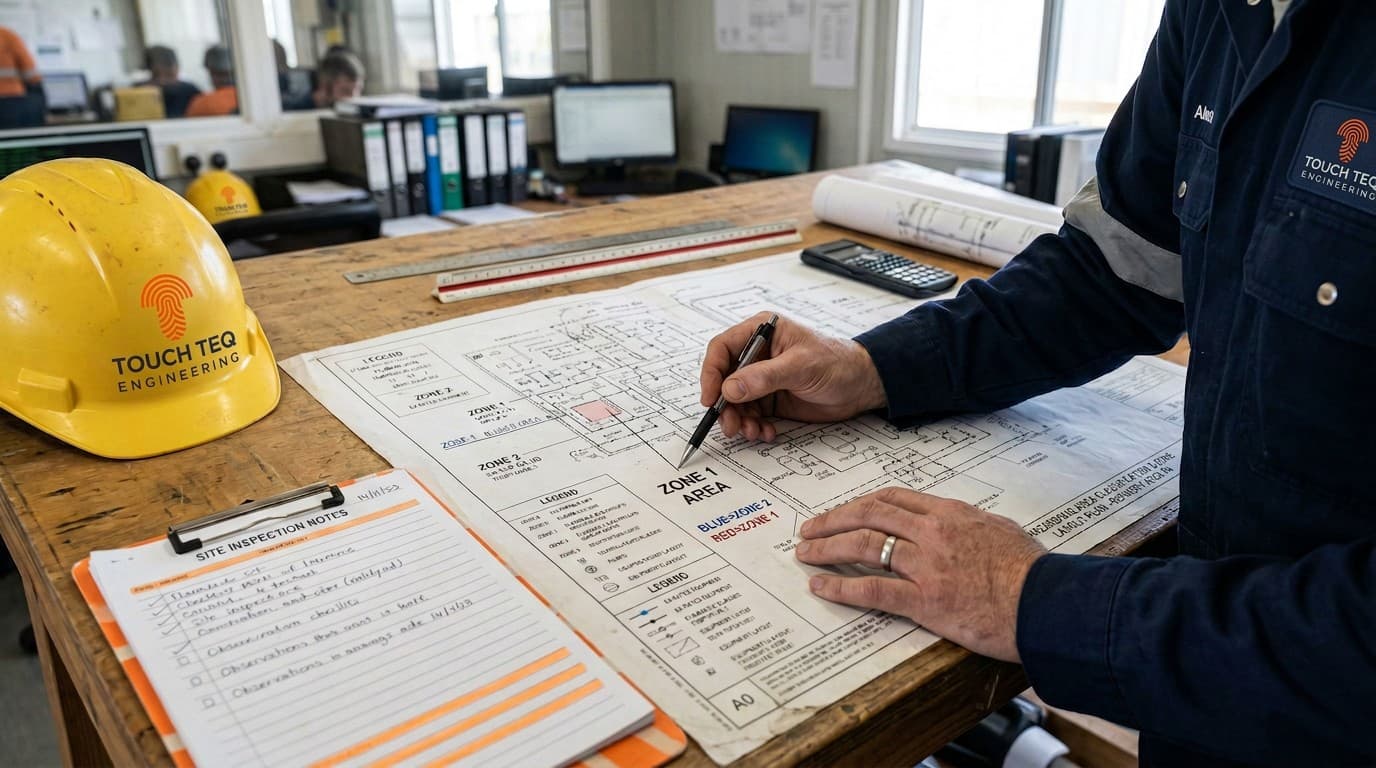
Engineers Who Understand the Science
We understand gas group properties, vapour density behaviour, and ventilation modelling. We do not apply generic templates; every classification is site-specific.
Integrated Engineering Capability
As E&I engineers, we understand the downstream impact of classification on equipment selection, cable routing, and installation costs.
Clear and Actionable Reports
Our reports are written for plant managers and maintenance teams. Zone definitions are clear, drawings are legible, and recommendations are prioritized.
Deep Regional Experience
We have delivered HAC studies across Southern Africa, applying international best practices within the local regulatory framework.
Single Point of Responsibility
From site assessment to final report, you deal with one team. We own the deliverable from start to finish.
The Cost of
Getting It Wrong
Facilities that operate without a valid hazardous area classification, or with one that has not been updated following process changes, are exposed to serious risk on multiple fronts.
Safety & Regulatory Risk
Incorrectly rated equipment is an ignition source waiting for a flammable atmosphere. Regulatory bodies can issue prohibition notices, stop operations, and pursue prosecution.
Financial & Reputational Risk
Insurers may deny claims arising from incidents in areas not properly classified. A serious incident will damage your standing with regulators, clients, and communities.
"The investment in a proper HAC study is small compared to the cost of getting it wrong."
Practical Answers to Common
Hazardous Area Questions

Is Your Facility Classification
Current and Documented?
Whether you need a new classification study, a review of existing zones, or an independent documentation review, our engineers are ready to help.